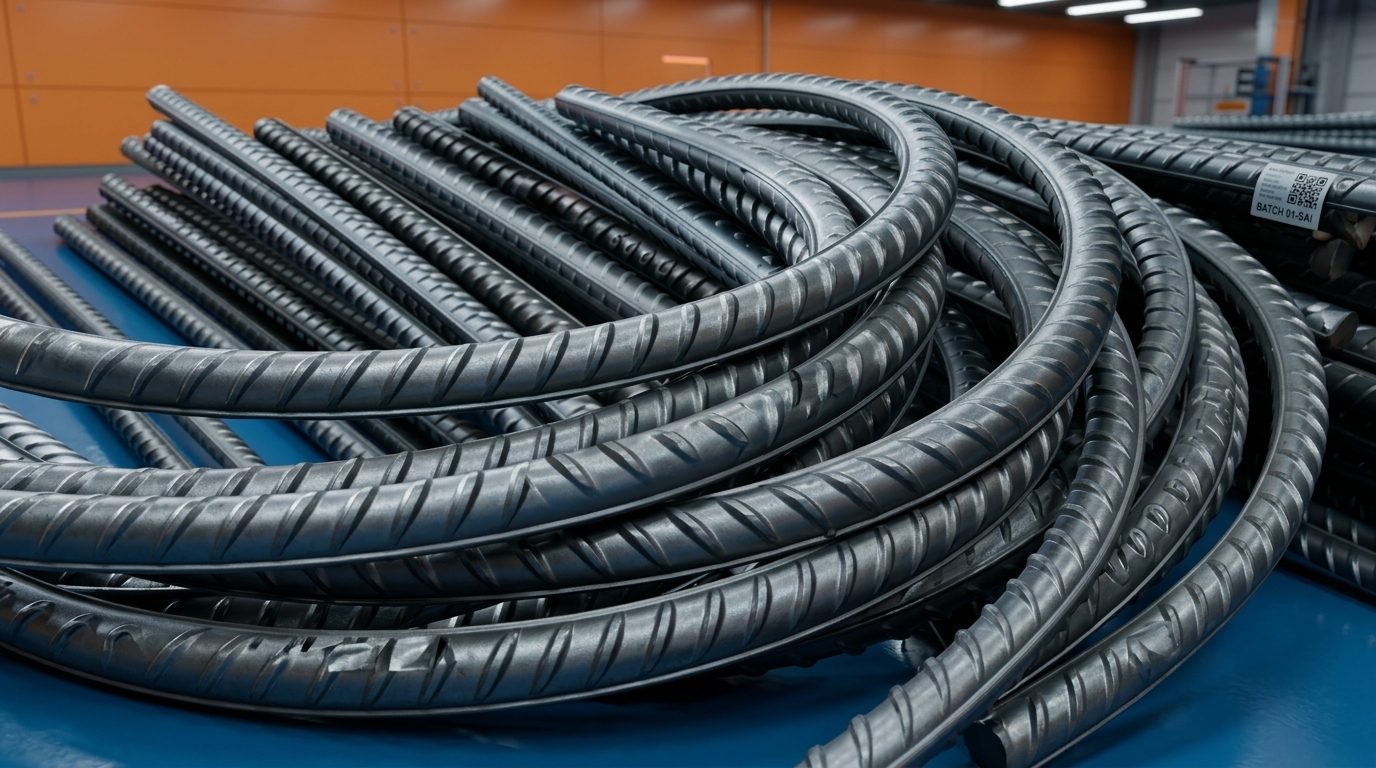
Every TMT bar on a construction site looks like a single, uniform piece of steel. It isn't. Cut one in cross-section and you'd find two distinct structures fused into one bar, a hard outer rim wrapped around a softer, more workable core. That combination is not an accident of rolling. It's the deliberate result of a process called TEMPCORE, and understanding it explains almost everything about why modern rebar behaves the way it does.
Where TEMPCORE Came From
TEMPCORE was developed in the early 1970s by the Centre de Recherches Métallurgiques (CRM) in Liège, Belgium, specifically to produce high-strength, weldable reinforcing bars from ordinary mild steel, without adding costly alloying elements to do it.1 Instead of changing the steel's chemistry, CRM changed what happened to the bar in the few seconds after it left the last rolling stand.
The name itself describes the mechanism: the martensitic outer layer is TEMPered by heat retained in the bar's own CORE.1 By 2018, CRM Group had commissioned its 100th industrial TEMPCORE installation worldwide, and its engineering division has since designed and commissioned more than 68 high-performance TEMPCORE plants globally.2 TEMPCORE® remains a registered trademark of CRM Group, licensed to rolling mills that adopt the process.2
Three Stages, One Bar
The process happens in three tightly sequenced stages, all within moments of the bar leaving the mill:
- Quenching: The hot bar, rolled at roughly 1000–1200°C, passes through a bank of water jets immediately after the final rolling stand. This rapidly cools the surface layer far faster than the core, transforming the outer skin into hard martensite while the interior stays hot and austenitic.
- Self-tempering: The bar leaves the water box and re-enters air. Heat still trapped in the hot core flows back out toward the surface, "tempering" that martensitic layer into a tougher, less brittle structure known as tempered martensite.
- Air cooling on the bed: The remaining heat in the core slowly transforms it into a ferrite-pearlite structure, softer and more ductile than the rim.
The finished bar is a composite: a hard, wear- and load-resistant tempered-martensite shell around a ductile ferrite-pearlite core.1 The two work together, the rim gives the bar its strength rating, the core gives it the ability to bend into a hook or stirrup on-site without cracking.
The zones inside a single barTempered martensite rim, a transition zone, and a ferrite-pearlite core, all produced from the same billet, in the same pass, without a single added alloying element.
What Fe 500D Actually Certifies
In India, TMT bars produced this way are tested and certified against IS 1786:2008, the Bureau of Indian Standards specification for high-strength deformed steel bars used as concrete reinforcement.3 The grade naming follows a simple logic: the "Fe" stands for ferrum (iron), the number is the minimum guaranteed yield strength in newtons per square millimetre, and a trailing "D" denotes an additional ductility requirement, tighter limits on elongation and the ratio between ultimate tensile strength and yield strength.4
An Fe 500D bar, in other words, isn't just rated to yield at 500 N/mm², it's independently certified to bend, elongate and absorb sudden load without snapping, which is precisely the behaviour TEMPCORE's dual-phase structure is built to deliver. This is also why TMT bars are considered well-suited to seismic zones: the ductile core gives a structure a way to flex and dissipate energy during ground movement rather than fail suddenly at a rigid joint.
Grade certification and Fe 550D TMT bar price are two different conversations. Yield strength, ductility class and IS 1786:2008 compliance are fixed by the standard; price moves with diameter, order volume and prevailing input costs, which is why we quote it against a specific project requirement rather than publish a flat rate.
Why It Replaced Older Rebar
Before TEMPCORE, achieving comparable strength in reinforcement bars typically meant cold-twisting mild steel bars (producing "CTD" bars) or alloying the steel with additional elements, both of which either compromised ductility or added cost. TEMPCORE achieved higher strength using the heat the mill was already generating, with no extra alloying spend, which is a large part of why the process spread to rolling mills across the world, India included.1
Every Elegant and Thermocon TMT bar leaving Shakambhari's mills is shaped by this same quenching discipline before it's tested against IS 1786:2008, the same standard, the same physics, applied at scale.