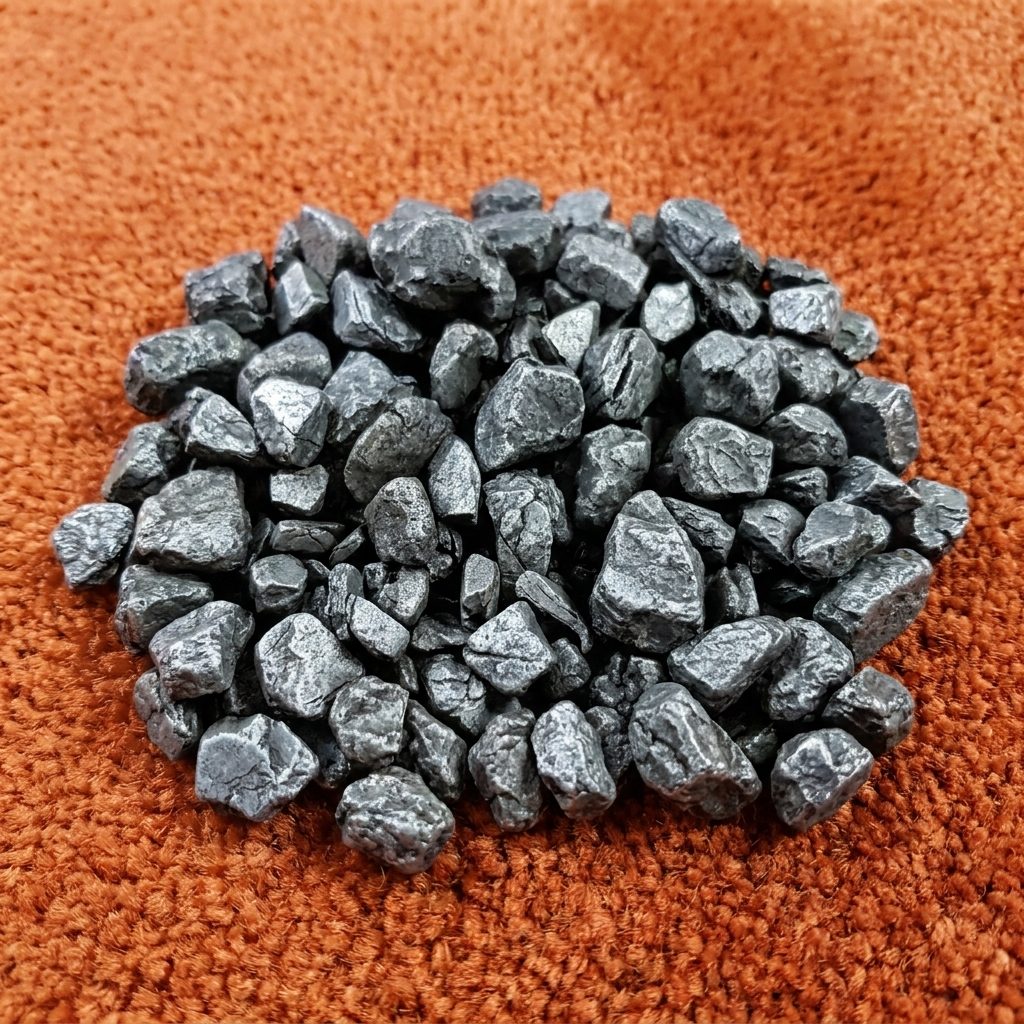
India has held the title of the world's largest sponge iron producer since 20031, but the more interesting question isn't that India leads, it's why the route that produces sponge iron took root here more than almost anywhere else, and stayed the dominant path to steel for two decades running.
What Sponge Iron Actually Is
Sponge iron, more formally, direct reduced iron (DRI), is solid-state metallic iron made by removing oxygen from iron ore without ever melting it. A conventional blast furnace reduces ore in a liquid state at extremely high temperatures, using coking coal as both fuel and reducing agent. The direct reduction route instead heats iron ore pellets or lumps alongside a reducing agent, coal, in India's dominant route, or natural gas elsewhere in the world, inside a rotary kiln, at temperatures around 950°C, low enough that the iron never fully melts. What comes out is a porous, "spongy" solid, metallic iron with the oxygen stripped away.
Why the Coal-Based Route Suits India Specifically
Most of the world's DRI capacity, particularly in the Middle East, runs on natural gas as the reducing agent. India's route runs overwhelmingly on coal instead, and that difference tracks directly to what each region actually has in the ground. India holds large domestic reserves of non-coking coal, the grade unsuitable for blast furnace coke-making but well suited to DRI kilns, while it has comparatively limited and expensive natural gas. A coal-based rotary kiln also scales down more easily than a blast furnace, which needs enormous, capital-intensive infrastructure to be viable at all, that lower barrier to entry is a large part of why DRI production in India has historically been dominated by small and mid-sized producers rather than a handful of integrated majors: in FY 2024, small and mid-sized companies accounted for 71% of the country's DRI output, with large companies making up the remaining 29%.2
The Numbers Keep Climbing
India's DRI output grew at a compound annual growth rate of roughly 8% between FY2019 and FY2024, rising from 34.7 million tonnes to 51.5 million tonnes over that span.4 More recently, production between April and September 2025 came in around 29 million tonnes, up 9% on the same period a year earlier.6 Installed capacity stood at approximately 63 million tonnes in FY23, with industry projections putting India's DRI capacity at around 68 million tonnes by FY25 and production crossing 75 million tonnes by FY30.3,5
That growth matters beyond the DRI plants themselves, because sponge iron isn't really an end product, it's a feedstock. It's the primary charge material for induction and electric arc furnaces making finished steel, standing in for (or supplementing) imported scrap and pig iron in markets, like much of India, where high-quality scrap isn't reliably available at the volumes a modern furnace needs.
From Kiln to Furnace, Without a Middle Step
For an integrated producer, DRI is where "raw material" starts turning into "our material." Iron ore and coal go in; sponge iron comes out; that sponge iron goes directly into the same company's own induction furnace as the primary charge, alongside scrap, pig iron and in-house ferro alloys, to be melted into billets. Each of those steps sitting under one roof, rather than sponge iron being bought from one supplier, scrap from another, and alloys from a third, is what backward integration in Indian steelmaking actually looks like in practice. Downstream, that melt is cast and tested against IS 2830, the Bureau of Indian Standards specification for the MS billets that re-rolling mills turn into TMT bars and structural sections.
Shakambhari's own rotary kiln reduces coal and iron ore pellets into sponge iron at roughly 950°C, the same process described above, feeding directly into our induction furnace route.