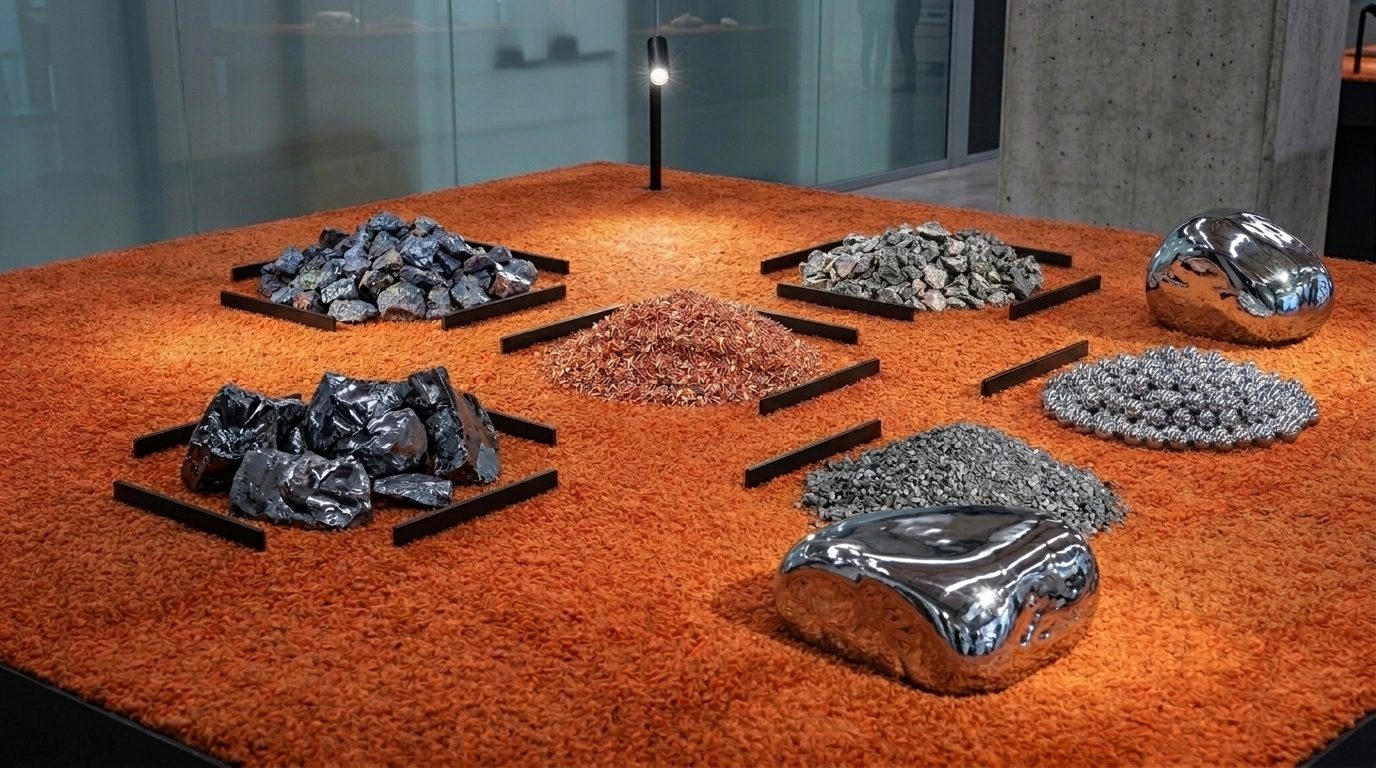
Almost no steel is made without it, yet silicomanganese rarely gets named outside the plants that produce and consume it. It isn't a finished product anyone builds with directly, it's an input, added by the tonne into a steelmaking furnace to do a job that neither of its two component elements can do as well alone.
How It's Made
Silicomanganese is produced by carbothermic reduction, using carbon as the reducing agent, of manganese ore inside a submerged arc furnace (SAF).1 The furnace charge combines manganese ore, a siliceous source such as quartz, and a carbon reductant like coke or coal. Inside the furnace, temperatures in the coke-bed zone climb high enough that manganese oxide and silica in the slag are reduced simultaneously, releasing manganese and silicon that dissolve into the molten alloy.2 Peak process temperatures in silicomanganese smelting can reach 1600°C or higher.2
The finished alloy typically contains 65–68% manganese, 12.5–18.5% silicon, and 1.5–3% carbon2, composition ratios that are controlled tightly, because the exact grade a steelmaker orders (commonly described as, for example, "65/16" for 65% manganese and 16% silicon) determines what it can be used for downstream.
What It Actually Does in a Melt
Steel coming out of a furnace is full of dissolved oxygen, left over from the oxidation reactions used to burn off impurities. Left alone, that oxygen would react with carbon during solidification and produce a porous, defect-riddled casting. Deoxidizers are added specifically to combine with that oxygen and pull it out of the melt before it can cause damage.
Silicon is a strong deoxidizer on its own. So is manganese. But using either alone is inefficient: when manganese or silicon deoxidizes a melt by itself, the burning loss rate, the amount consumed and wasted in the reaction, runs to roughly 46% and 37% respectively.3 Combine them in a single alloy and that loss rate falls to around 29% for both elements together.3 Manganese and silicon deoxidize more efficiently as a pair than either does solo, and silicomanganese exists specifically to deliver them as a pair, in a controlled ratio, in a single furnace addition.
Why the alloy beats either element aloneCombined Mn+Si deoxidation cuts burning loss to ~29%, versus 37–46% when either element is added by itself, a meaningfully more efficient use of the same furnace addition.
Deoxidizer and Alloying Agent, at Once
Silicomanganese does two jobs in the same addition. As a deoxidizer, it removes dissolved oxygen, forming manganese-silicate compounds that float out of the melt into the slag.3 As an alloying agent, whatever manganese and silicon remain dissolved in the steel become part of its final chemistry, manganese improves hardenability, strength and wear resistance; silicon contributes to strength and elastic properties. That dual role is precisely why steelmakers who need to add both elements together, in a fixed ratio, standardise on silicomanganese rather than sourcing ferromanganese and ferrosilicon separately and blending them at the point of use.
From Furnace to Furnace
For an integrated steel producer, silicomanganese sits at a useful junction: it's a finished product in its own right, sold to steelmakers who don't smelt their own alloys, and it's also a direct input back into a company's own induction or electric arc furnace, feeding the very steel it will later leave as reinforcement bar or structural section. Producing it in-house, rather than buying it on the open market, removes a link in the supply chain that would otherwise sit between mining the ore and rolling the finished steel.
Shakambhari's Eloquent Steel unit smelts silicomanganese in-house for exactly this reason, a portion feeds our own induction furnace, and the surplus is sold externally to other steel producers. That dual role, submerged arc furnace ferro alloys producer and silico manganese exporter to steelmakers across India, is what backward integration looks like applied to alloys rather than iron.